



Week 9 - Tajikistan and back into Kazakhstan
Day 59 - Khujand
Thursday, 8 October 2026
Start: Dushanbe (TJ) 10:30
Arrival: Khujand (TJ) 17:20
Total: 298 km
We nicknamed this day "the day of accidents". Not ours, thank God, but we saw so many on the way that I was getting seriously spooked in the end.
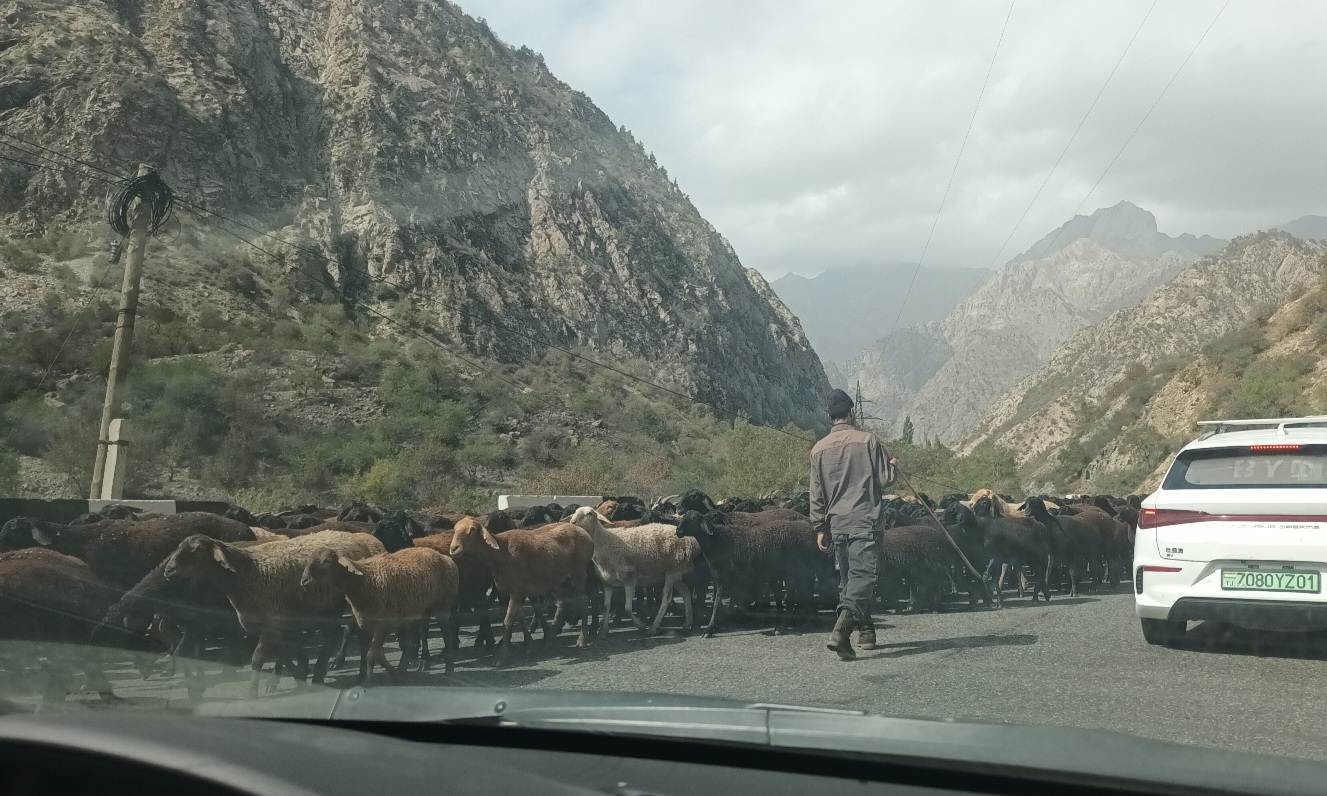
The plan for today was crossing the mountains of Tajikistan from Dushanbe back to the North and then East to Khujand. We encountered more than one "organic" traffic jam, but unlike the rather uncaring Uzbek and Kyrgyz shepherds, the Tajik made an effort to keep their flock to one side of the road only. The drivers were grateful, one of them even gave two boys herding sheep some apples to munch. "Shouldn't they be in school?" Sonia wondered. The Central Asian school hours were a mystery to us. At all times of the day, we saw children playing or hitchhiking along the road. Sometimes in school uniform (we suspected them to be skipping classes), often just in normal clothes.
There are about two dozen tunnels between Dushanbe and the northern town of Ayni, most of them much shorter than the five-kilometre long Istiqlol tunnel. Unfortunately, the smaller ones all are pitchdark and without ventilation. Who needs lights when a tunnel is only one or two kilometres long, right? I entered each one of them thinking "I so hope we won't find a stranded car in there." It's what you fear, but it's not what you really believe will happen. Well, in one of the first tunnels, we hit upon a collision. When we saw a man walking past us, I slowed down, just in time for a full break in front of two cars blocking my path. A look in the rear view mirror: unfortunately, no one right behind me. If the next car was a speed freak or a truck, he'd hit me before he ever saw me. I needed to pass the accident site ASAP, which meant getting into the oncoming lane right before a bend in the pitch dark tunnel. "It's dark, you would see the oncoming lights, go, go", Sonia urged me on, as eager as myself to get out of this hazardous situation. I pushed the gas pedal down and a minute later, we were out in the light again.
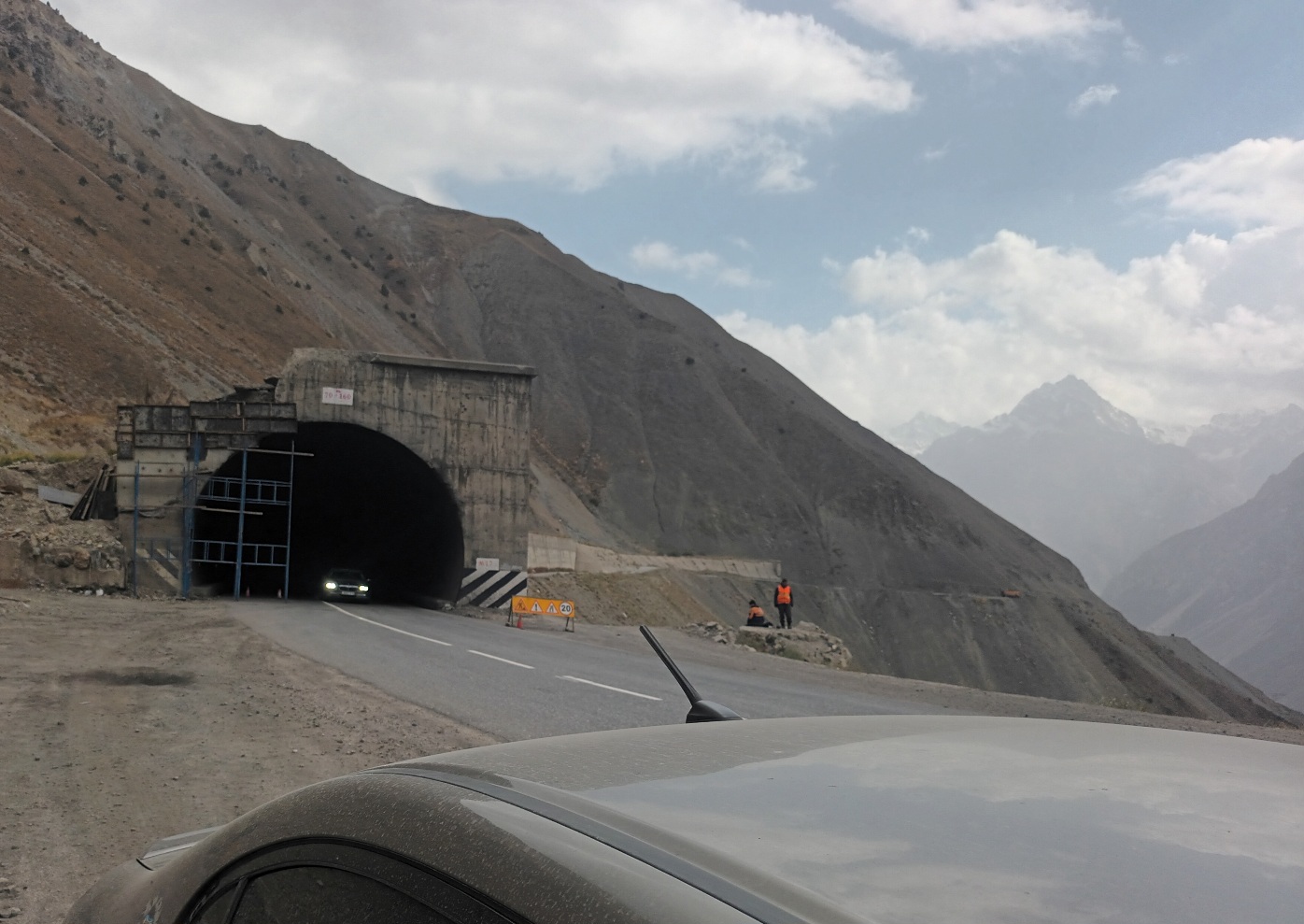
Not much time to ponder this accident, as we were approaching the next hazard. On our way down to Dushanbe, the tunnel just after the Tunnel of Death had a scaffolding in front of it, meaning the cars getting out of the tunnel needed to cross into the oncoming lane to get out. When we had been about to enter this tunnel, a car had sped past us in our lane, almost causing us to crash. Today, we would be the ones exiting the tunnel in the wrong lane, and again there was a bend just when you least needed it. Although I was mentally prepared for the scaffold, the tunnel was so foggy that I saw it at the last second. Here goes nothing, please don't let a truck thunder in just now, I sped out as fast as I dared, ready to make a hard right to avoid a head-on collision. Daylight. Out. Stopping at the side. I needed to digest this. We took a pic, because else who would believe that such a thing was even possible? I know a few Luxembourgers who were outraged because the Grouft Tunnel, not even 3-kilometres long, had only safety bays every few hundred metres but no continuous hard shoulder. Oh sweet summer child. Don't even think about driving in Tajikistan.
I took the Istiqlol "Tunnel of Death" with slightly more aplomb the second time. It seemed less fogged-up with exhaust fumes than a few days ago. Hardly any traffic in it either. Nevertheless I was longing to see daylight again. Call me a coward, but I was tense as hell in there. When we shot out into the sunshine, we calculated my average speed. Sonia had stopped the time it took us to drive the 5,040 metres: 6 minutes 46 seconds. That's an average of 45 km/h. Almost seven minutes of hyper vigilance, trying to pierce through a wall of dense fumes. I don't mind admitting that I was glad I didn't have to do this a third time. The worst was behind us. Little did we know...
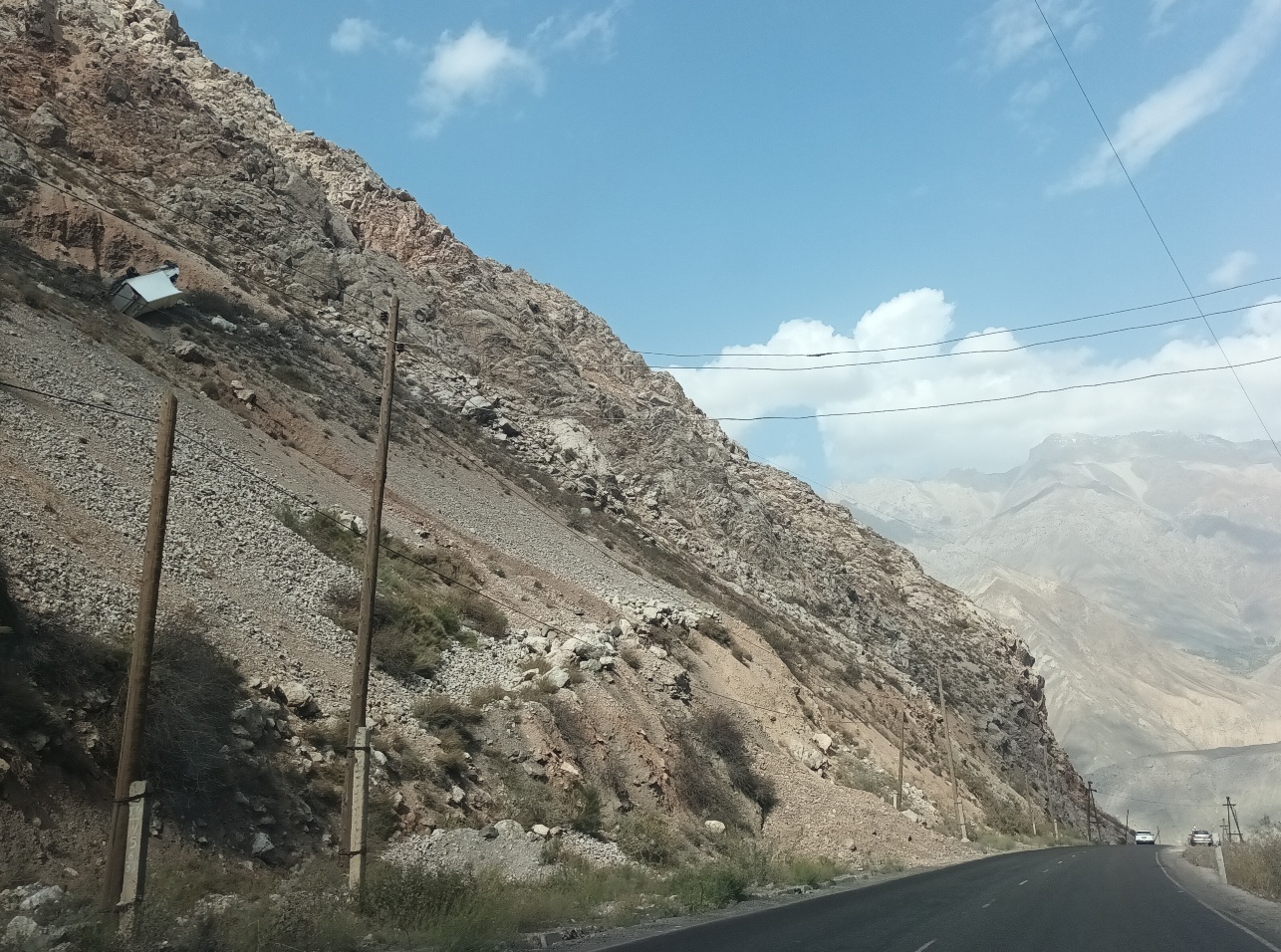
Winding our way down the hairpin serpentine, we saw men standing by the road, staring down. A truck had not made the bend and slid down the slope (picture 3). We could only hope that the driver had gotten out safely. Second accident within an hour. What a day.
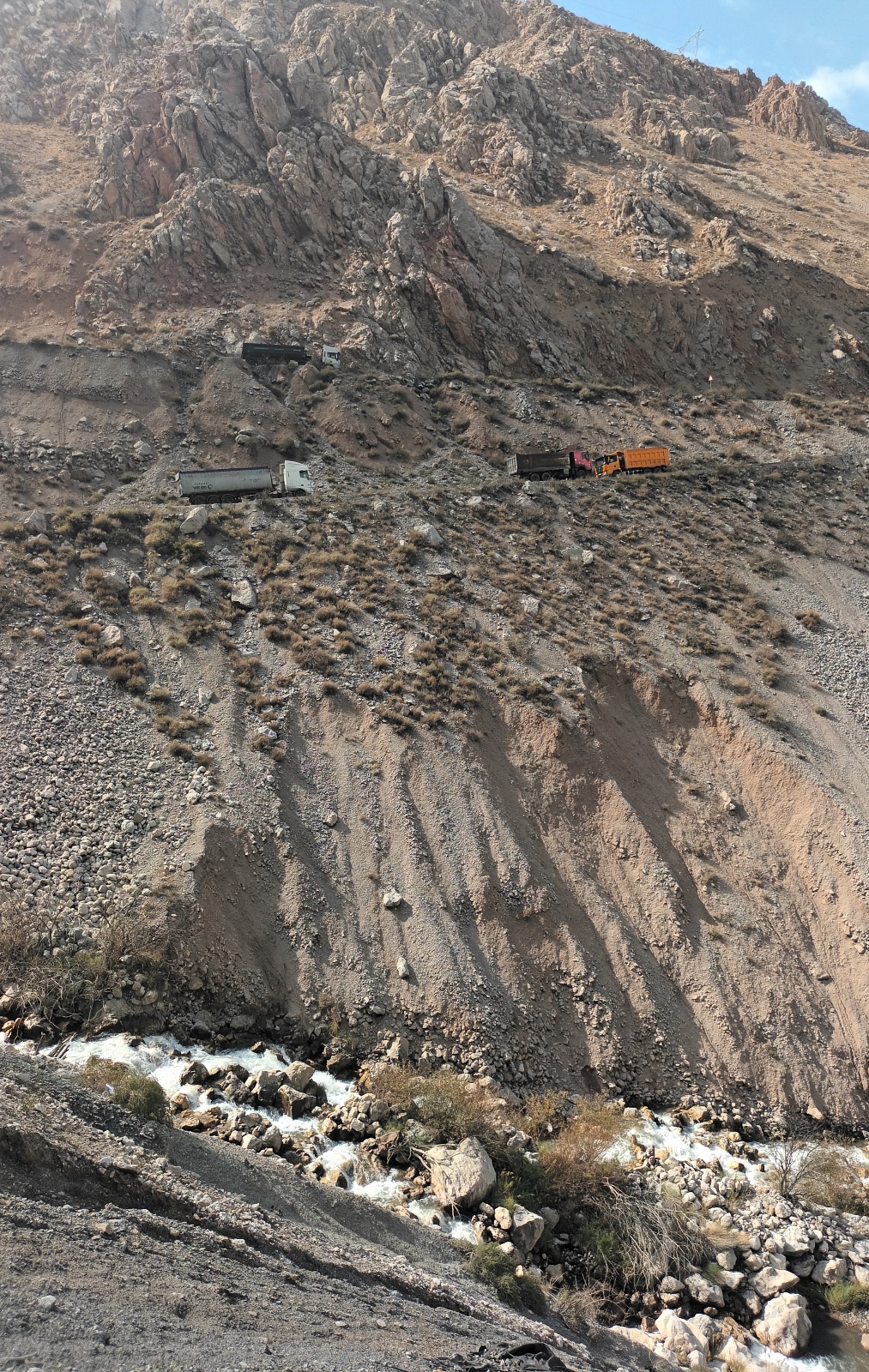
We stopped mid-way down the mountain to enjoy the view. A mountain river gurgled deep below us, the trucks tiny up on the mountain road. It was beautiful beyond words, but like all things truly beautiful, it was profoundly dangerous as well. There is a reason the word awe-inspiring and awful share the same root.
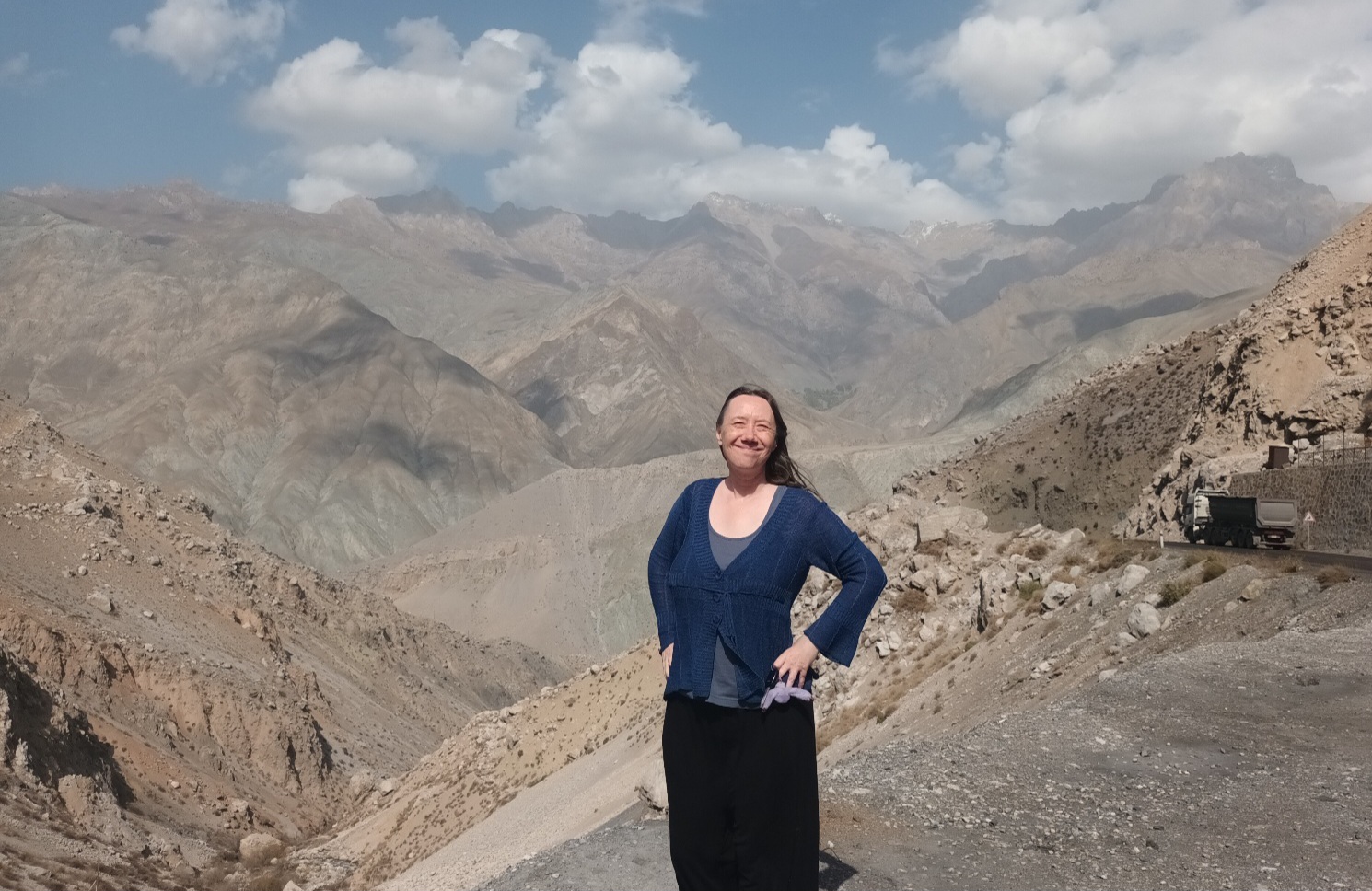
Close to the small town of Ayni, there is a fork in the road: one leads straight up to Panjakent and Samarkand. That's the way we had come down earlier this week. The other leads east, to Khujand. That's where we were headed now. And that meant yet more mountains, even higher and steeper than the ones we had just come out of.
The grandeur of it! This was what I had dreamt of when I had planned this trip. One mountain folding into the next and the next one beyond that, as far as the eye could see. Soft brown slopes all around, sheer grey rock in the distance, a crown of white somewhere on high, and towering above it all, the dark blue sky. Who needs a mosque or a cathedral when there are sights like these?
We had stopped next to a truck driver enjoying a smoke. "Where are you from?" he asked, when we headed back to our car. "Luxembourg!" He nodded. "Have a good trip." I wish some of these impromptu conversations would go beyond the same three questions and answers. But my Russian is really not that great, especially not my listening skills. Maybe it's too much to ask too, on a gravel sideway in the middle of the northern Pamir range.
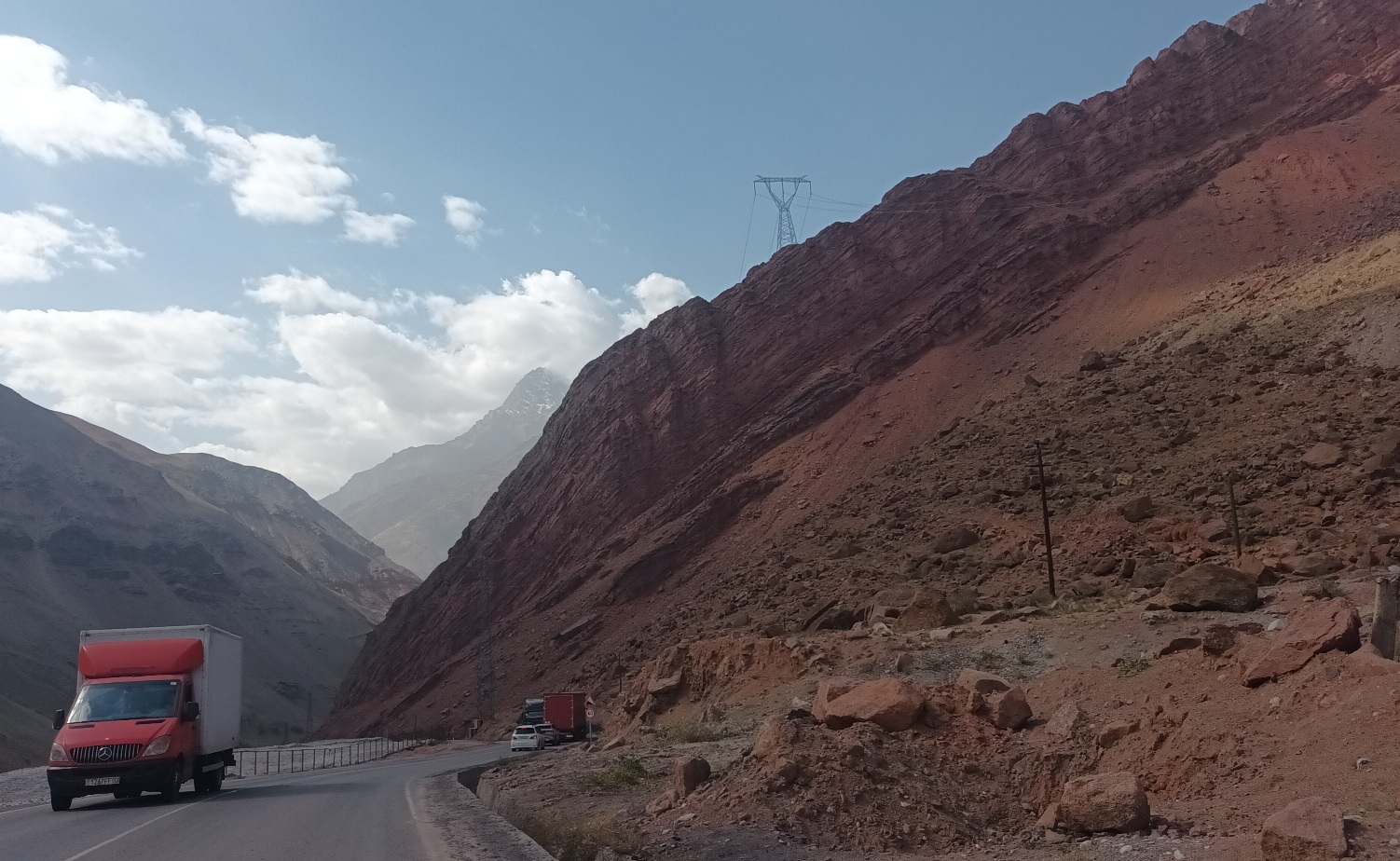
This region is a geologist's dream. So many interesting formations and strata. Just imagine the tectonic forces necessary to fold these blood-red rocks up into a near vertical position! The road wound through endless canyons, megatons of rock looming above us. None of it was visibly secured, no nets or bolts to prevent a landslide or a rock crashing down. Beautiful and dangerous.
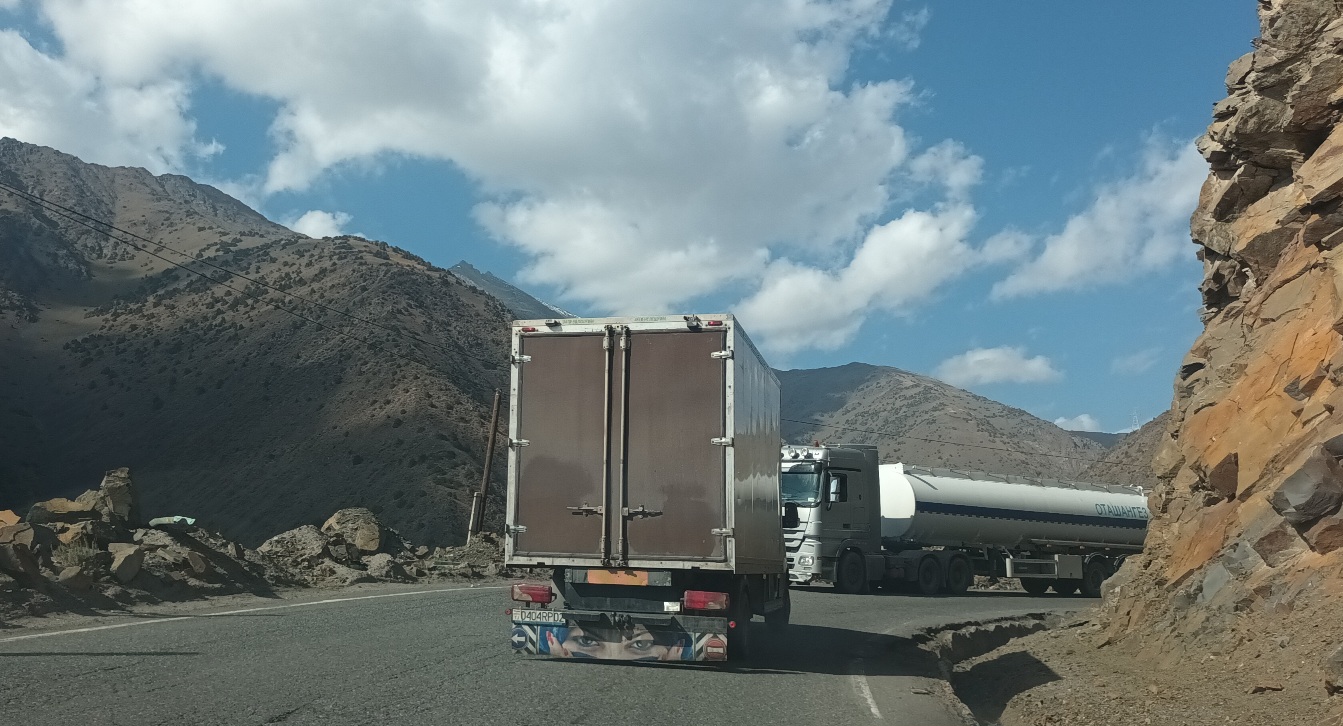
We passed many trucks. One of them had a cool picture on his rear guard. A woman's eyes staring at you. Sonia managed to capture it on camera.
Soon, the road climbed up steeper than ever before. The trucks took the hairpin curves by swerving into the opposite lane. Which forced the oncoming cars to steer to the left, into the lane the car behind the truck was in. It made for interesting driving. "We're so very high up", Sonia said. I had one short
look over the abyss. No railing to speak of, a gaping nothing to the right of us, the mountains on the other side so very far away. And to our left, trucks thundering by, inches from us, inches from the rock wall too. I felt what I only ever feel on high bridges: a surge of panic, cold sweat, the feeling of tilting backwards. Not the moment. Deep breath. Irrational fear leads to real danger. I forced myself to look closer: this was not a bridge, we were on solid ground and if I kept my wits together, there was no reason not to enjoy it. I relaxed. The moment passed. All good again. "It's grand, isn't it?" I asked. My sister had to agree. It was pretty awesome. There was that same root again: awe.
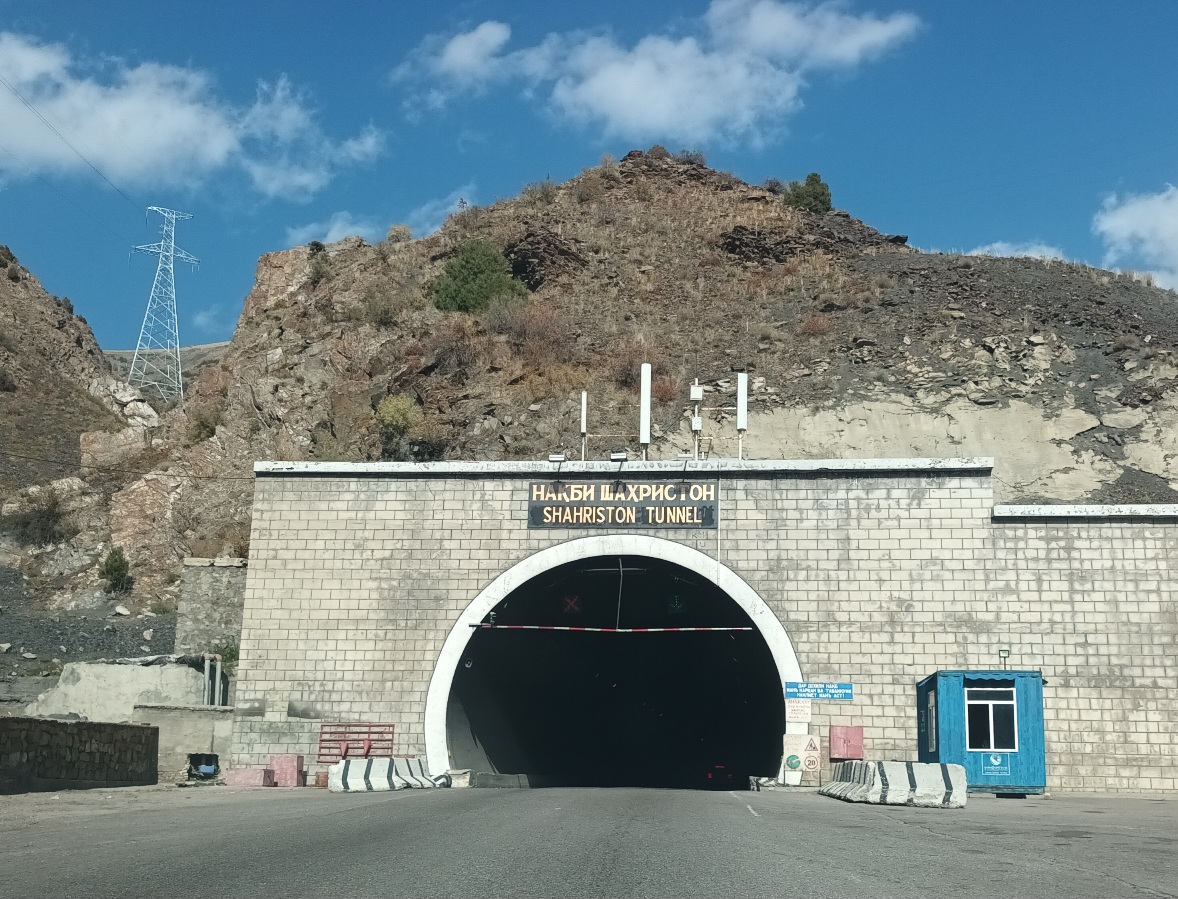
What goes up must come down. We had reached the top of the pass and that meant again a tunnel. Its name: Shahriston, never heard of it. I won't forget it in a hurry though. So very dark inside, full of fumes. After driving for most of the day, I was not prepared for this. How long was this thing? We were steadily going downhill, so I had to break too. A car approached from behind, blinking his headlights, urging me to go faster. No way, mate. I don't see squat in here. The car passed me in the oncoming lane. Was he crazy? I breaked harder, he swerved back into our lane right in front of me, seconds before a truck thundered past us. Heart racing, I speeded up. Now that I had a pilot car, I didn't want to be left in the dark again. I followed the tiny pins that were his backlights, noting which way the tunnel bent and the bumps in the tarmac. The tunnel was endless. Or rather, it was 5,200 metres long, the country's longest tunnel. About a minute before the exit, we saw our third accident for the day: two cars blocking the oncoming lane. I drove by, trying not to imagine that there might easily have been a car passing them in my own lane. What was it with this day and all the lunatics on the road? This was getting spooky.
But now we were further down in the valley again. Toll booth. Tajikistan's roads are in good condition, but they are not for free. And they don't take foreign credit cards. I was in the wrong lane. Reverse gear and into the truck lane, as that's the only manned booth where you can pay cash. I rubbed my neck. I needed a break soon.
Instead, I got to witness car crash number four. It looked real ugly, both cars severely damaged. Next to them lay an animal carcass. "It's a donkey", Sonia said, "why do these people drive like maniacs? I feel so sorry for the animal." So did I. And she was right: why were they in such a hurry? The same slightly lethargic, laid-back people we saw waiting patiently at the road, taking their time at rest places, laughing and chatting forever at a café or shop - as soon as they got behind a wheel, every second seemed to count: flashing headlights, honking, almost running over pedestrians crossing the street, passing the car that was just passing another one. Crazy and irresponsible. And now an innocent animal was dead.
Khujand
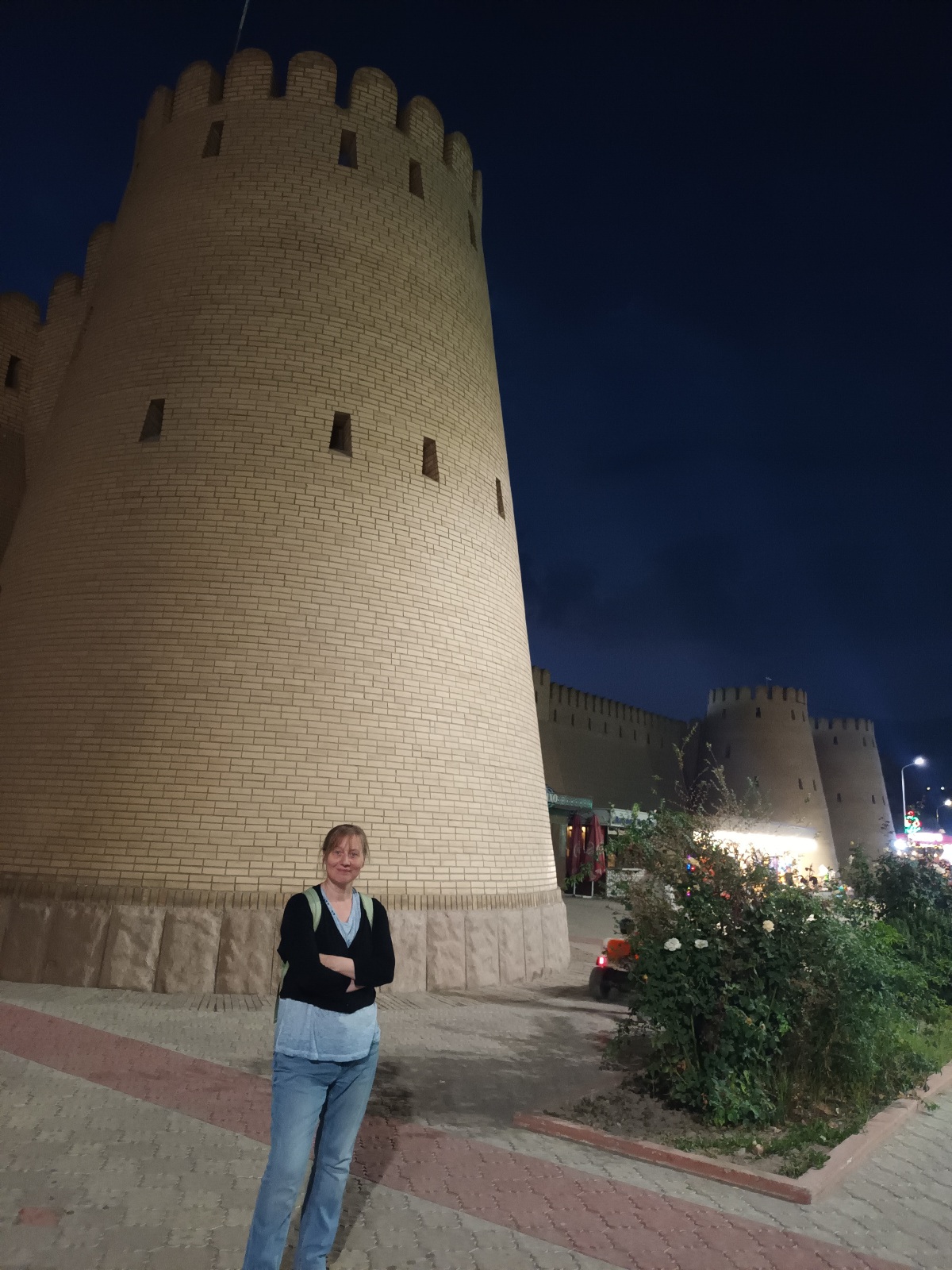
In the end, we did not make a break after all. I wanted to be at the hotel before nightfall, which came early in this region. We made it into Khujand, a rather chaotic, smoggy and busy town, at twilight. "I don't know how people with breathing problems manage to survive here", I said. Wordlessly, Sonia pointed to a building: "Tuberculosis hospital". It would be hilarious, if it wasn't so sad. We found a parking spot right next to the main square, opposite our hotel. I manoeuvered the car over the damaged grille covering the inevitable canal, parked, took the key out of the ignition and closed my eyes. Done for the day. "Should we take the big suitcase or is the overnight bag enough?" Sonia asked. I grunted. Nope. No more decision-making from this side.
We checked in, were told to pay cash, ran back out to an ATM, got money to pay our self-proclaimed 4-star hotel, found out that our room was right over a café blaring out music and Sonia complained until the receptionist got us a slightly more acceptable room. All in a day's work. Now: food. The hotel restaurant had funny prices. Cheapest item: 11 euro for a Caesar's salad. In a country where a 10-minute cab ride costs less than 2 euros. So back out onto the street. By now it was dark and the lights had come on. We were right in the heart of the second largest city of Tajikistan. We strolled along the fortress (same Ark/Hisor-style!), through a park where locals enjoyed huge plates of piping hot shashlik for a tiny fraction of our hotel's Caesar's salad's price.
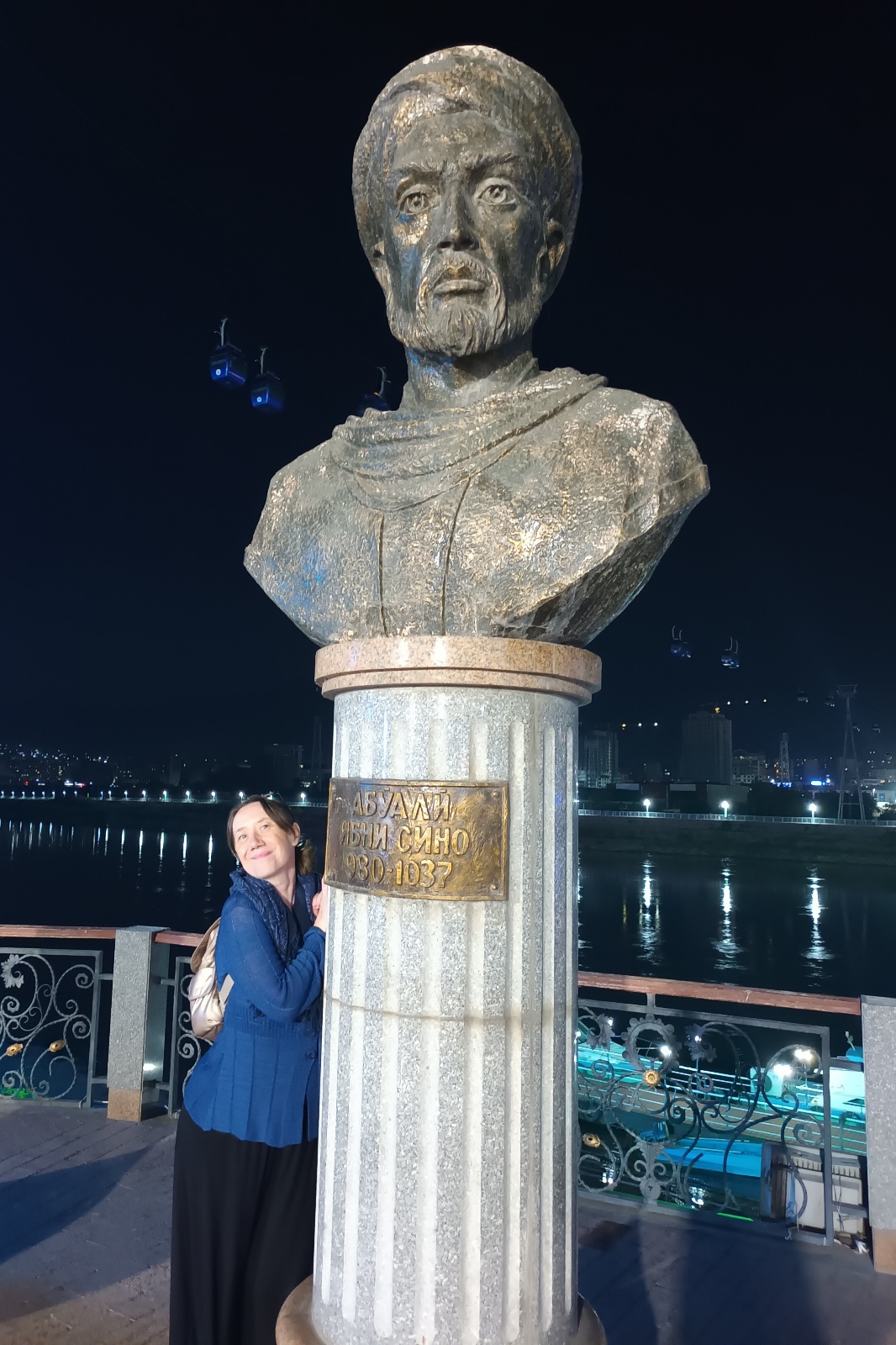
Behind the park, a street, and beyond that, lights twinkling over a pitch-dark surface: the Syr Darya, the ancient River Jaxartes, which we had already crossed twice or three times. "I want to see it from up close", I said. How to cross the street? Somehow, Sonia has natural authority. She held up her hand like a traffic cop and the cars stopped. I hobbled across (that muscle ache from Hisor fortress, remember?) There were statues of famous ancient people overlooking the river. "Ibn Sino", I read. Judging by the biographical dates, that must be Avicenna, the famous Persian polymath. The Syr Darya, Avicenna and me in one pic - what a cool way to end this day.
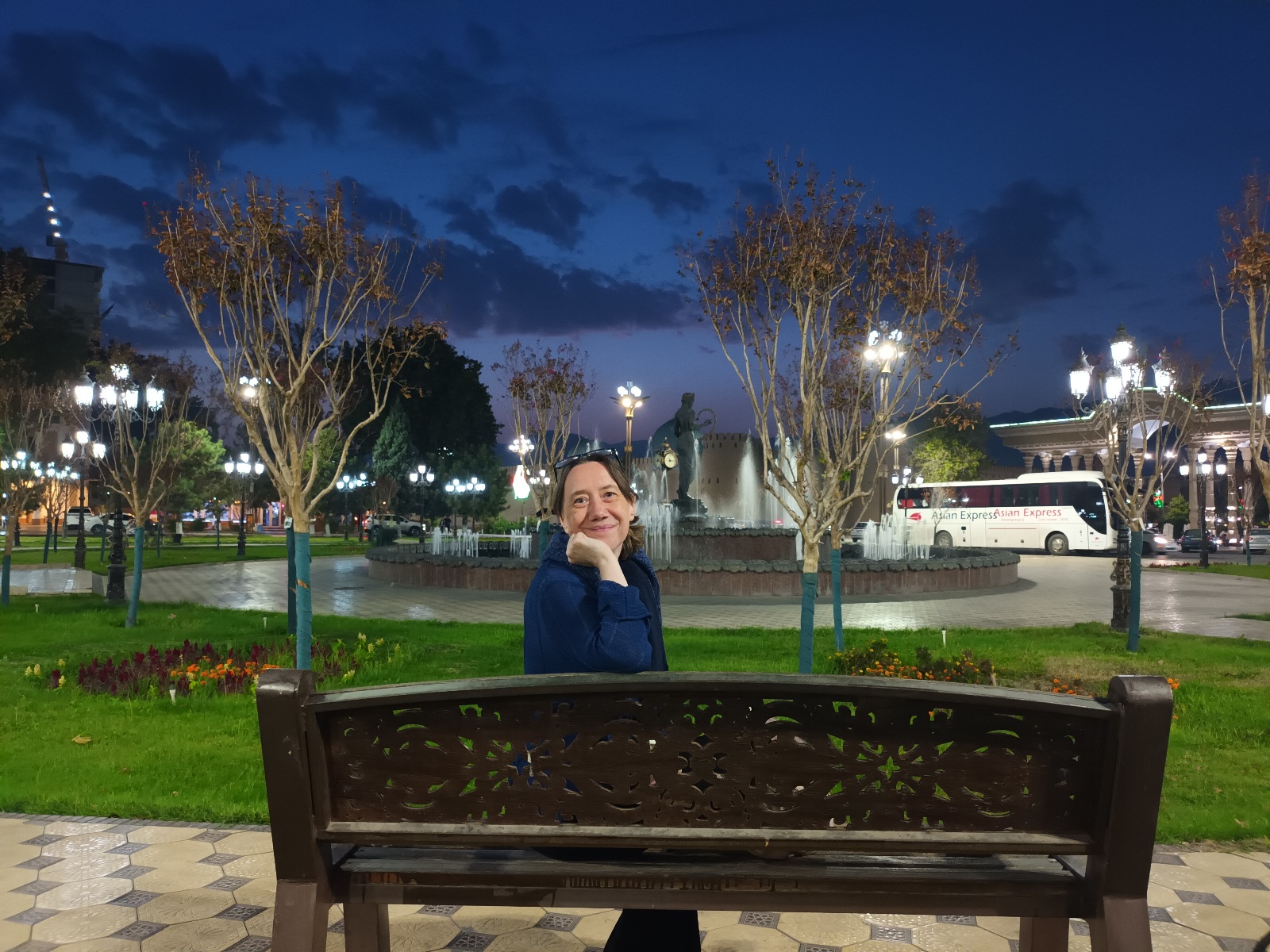
We walked back to the main square. We had not eaten anything since this morning. The restaurants around here looked okay, but when Sonia spotted a KFC right across the street, the choice was made. Sometimes, you just need a piece of home, even if that "home" is a US-American fastfood chain. The wings were delicious, the place was packed and our entire meal cost only half a Grand Hotel Caesar's salad. We're all living in America and, in some aspects, Amerika ist wunderbar.